the panama canal panama
With much celebration, on 31 December 1999 Panama received full ownership and responsibility of the Panama Canal thanks to the Torrijos-Carter Treaty signed in 1977. However, the Canal’s overwhelming presence in Panama has been felt for nearly 100 years. Acting as a water bridge that linked the Atlantic and Pacific Oceans, the Panama Canal has played a vital role in international commerce, ensuring the fluid, non-interrupted transportation of products and commodities worldwide.

With many new projects planned, and others having already been completed -- including the widening of the narrow Gaillard Cut and refurbishing of the Panama Canal Railroad - Panama is taking aggressive steps to ensure that both the country and Canal are adequately prepared to meet the challenges and reap the benefits of a more interconnected world.

History
The idea of digging a channel across this thin strip of land was first suggested in the 16th century by King Carlos of Spain, who ordered the first survey of possible routes. It would take almost 400 years to become a reality. The first serious attempt to create an ocean-to-ocean navigable canal in Panama began in 1879, when France’s Count Ferdinand de Lesseps, builder of Egypt’s Suez Canal, formed the Compagnie Universelle du Canal Interocéanique de Panama. Construction of the sea-level canal, which was to run alongside the Panama Canal Railroad, began in 1881 at Colon, on Panama’s Atlantic coast, but Panama proved to be more of a challenge than Suez. Various factors led to its faliure - the French’s inability to overcome tropical disease, geographic obstacles, financial mismanagement, and, perhaps most importantly, the decision to build a sea-level channel instead of a lock canal. As a result, the effort ended abruplty and the company was declared bankrupt in 1889. Shortly thereafter, in 1894, another French company known as the Compagnie Nouvelle du Canal de Panama, recommenced work on the Canal with the idea of constructing a lock-type canal, rather than a sea-level canal as had originally been planned. But unable to secure adequate financing, this company was forced to sell its rights and equipment to the US government, who in turn took over full responsibility for the construction of the Canal. During the French effort, an estimated 20,000 plus individuals died, predominately due to sickness.

Immediately following the signing of the Hay-Bunau-Varilla Treaty in 1903, between the US government and newly independent Panama, construction on the Canal once again proceeded. The Americans were in a better position than the French. Firstly, the task was headed by the state rather than a private company, and the government was willing to put large resources into the effort, believing it was essential to United States naval power and trade interests. Secondly, it was becoming more widely accepted that malaria and yellow fever were spread by mosquitoes. Military doctor William C Gorgas launched a campaign to clean up the isthmus aimed at eliminating the insects, successfully keeping disease under control. Although the United States considered alternative routes for the Canal, they settled on the same route the French had selected, which was to cross directly through the center of the Isthmus. Lasting 10 years and costing approximately $400 million to complete, a gigantic sum of money at the time and four times the cost of the Suez Canal, the construction of the Canal required the employment of more than 75,000 men and women including unskilled laborers, engineers, and technicians. It was the largest, most ambitious engineering project ever attempted until then in the world. In total, workers from over 90 different countries contributed, the overwhelming majority of which came from Jamaica and Barbados. Having succeeding where others had failed, overcoming the engineering, financial, climatic and health impediments, the Panama Canal opened for business on August 15, 1914 and has since then accommodated nearly 900,000 vessel transits.

When Panama originally agreed that the United States could build and run the canal, the treaty also gave the US the right to act "as if sovereign" over the ten-mile wide strip of land where the waterway would be built.

This zone became an American enclave in the middle of Panama, with its own governor, police force, courts, shops, post offices, churches and schools. Those who lived there mainly Panama Canal employees and their families were known as Zonians. The US flag was flown and Panamanians could not enter freely. US military bases were built, with tens of thousands of troops stationed here; as many as 68,000 during the Second World War.

Negotiations to find another arrangement were attempted without definitive success in the 1920's and 1930's. There was a series of anti-US demonstrations in the 1950's and 1960's and domestic pressure in the US began to grow. Talks between US president Jimmy Carter and Panama's leader General Omar Torrijos led to the Panama Canal Treaties of 1977.

The treaties went into effect on October 1, 1979, ending US control of the canal zone and creating the Panama Canal Commission, an agency of the US government. The canal and the military bases, it was agreed, would be handed over to Panama over a period of 20 years, culminating with the transfer of the waterway at noon on December 31, 1999.

In 1993, a few years before the United States fully transferred the Canal to Panama, Panama's national assembly passed a constitutional amendment creating the Panama Canal Authority (ACP), to assume sole responsibility for the management and operation of the Canal at treaty end. An autonomous government body, the ACP is managed by an administrator and deputy administrator, who report to an 11-member board of directors, ten named by the president of Panama and ratified by the legislative assembly, and one appointed by the assembly alone. The amendment also made the Canals administration independent of the government system. Transfer activities, however, began as far back as 1979, when the US government’s admini-strative, civil, and military institutions began a gradual drawdown.

Currently, the ACP employs approximately 9,000 full-time and part-time workers, and is the country’s second largest employer. The rigorous training and daily occupational requirements demanded of those who work on the Canal has helped forge the creation of one of Latin America’s most highly skilled, bilingual, and diverse work forces. This in turn has stimulated the country’s banking, transportation, telecommunications, and trade sectors, giving Panama one of Latin America’s most stable, dynamic, and attractive economies.

An ongoing engineering miracle that reflects the enthusiasm, commitment and persistence of so many, the Canal serves as Panama’s ecnomic and political engine. On November 3, 2003, the country will celebrate 100 years of independence, just three short years after assuming full ownership of the Canal. At this historic moment, Panama appears ready, willing, and able to reserve its pivotal role for the next 100 years.

Facts About The Panama Canal
• Construction on the Panama Canal began in 1881 under the stewardship of France’s Count Ferdinand de Lesseps, builder of Egypt’s Suez Canal, and culminated in 1914 under the leadership of U.S. Lieutenant Colonel George Washington Goethals, who had been appointed by President Theodore Roosevelt in April 1907.

• On September 7, 1977, U.S. President Jimmy Carter and Panamananian President Omar Torrijos signed the Panama Canal and Neutrality Treaties, which, collectively transferred full control of the Canal to Panama on December 31, 1999 and guaranteed permanent neutrality of the Canal. In addition, all U. S. military facilities and instalations in the Panama Canal Zone area were to revert to Panamanian ownership.

• The Panama Canal was officially inaugurated on August 15th, 1914 with the southbound transit of the “SS Ancon”, a cement boat piloted by Captain John A. Constantine. However, the first complete Canal transit took place on January 7, 1914 with the passage of the old French crane boat “Alexandre La Valley”.

• Madden Dam was constructed in 1935 to increase the holding capacity of the water for each of the locks. As well, it provides hydroelectric energy for the Canal and surrounding areas.

• On May 12, 1963 the Canal began operating 24 hours a day, after the installation of lights along Gaillard Cut and at all three sets of locks had been completed.

• 1990 marked the first time in history that the Canal’s administrator was a Panamanian citizen and deputy administrator was an American. Until that time the position of administrator had always been occupied by an American citizen.

• During the French era an estimated 22,000 died, predominantly from malaria and yellow fever, however, since the French only recorded the deaths that occured in hospitals the exact number will never be known. A total of 5,609 lives were lost from disease and accidents during the American construction era.

• An estimated 268 million yards of earth were excavated for the construction of the Canal, of which 200 million were removed from Gaillard Cut, the deepest portion of the Canal.

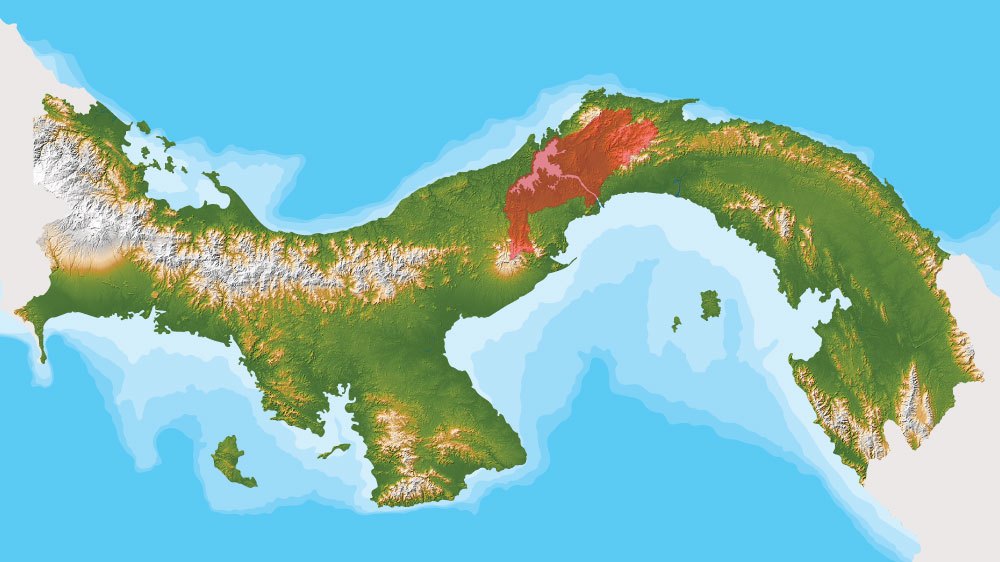
• The Panama Canal is a fresh-water canal, obtaining its water from a vast watershed which covers an area of 2,134 square miles that encompasses three different Panamanian provinces -- Panama, Colon and Cocle. Acting as a freshwater elevator, each vessel is lifted 85 ft. above sea level to reach the height of Gatun Lake, before being lowered back down to sea level on the Canal’s opposing side.

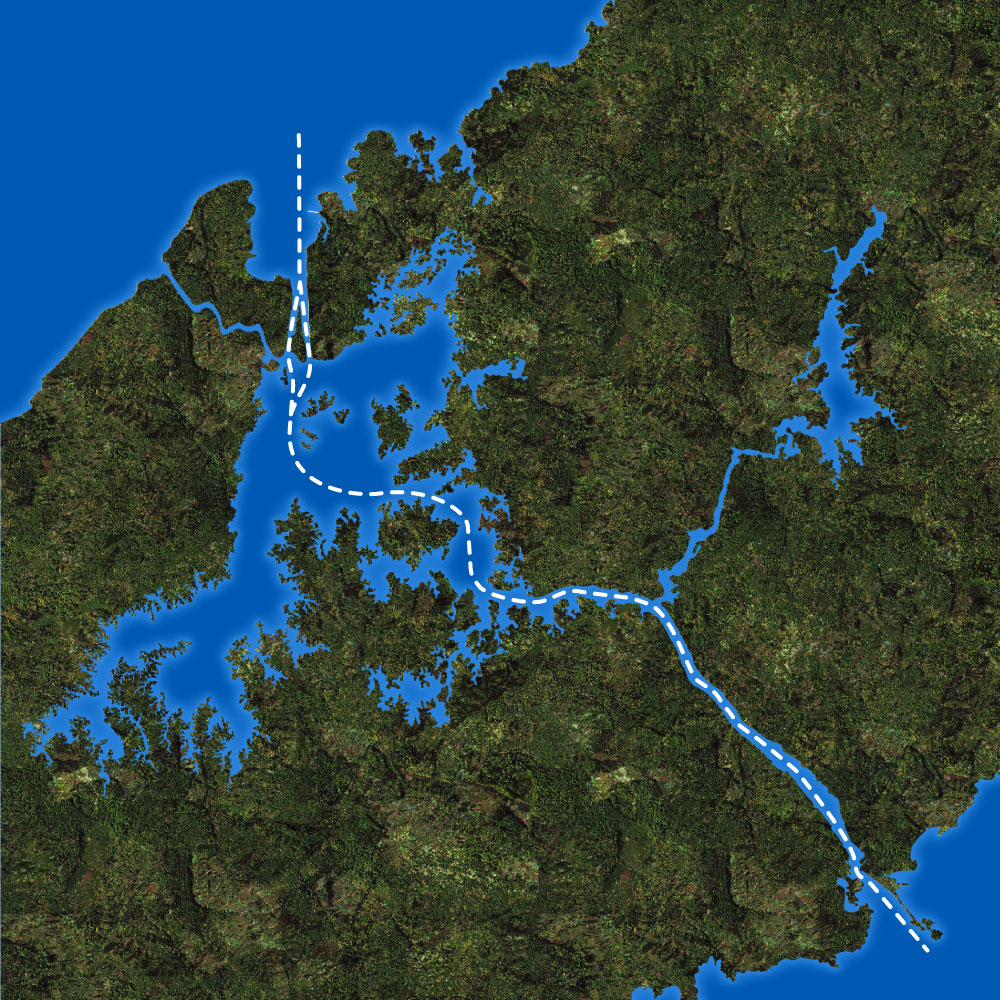
• The Panama Canal itself, a 50 mile-long waterway traveling northwest - southeast, is comprised primarily of: three sets of locks, Miraflores, Pedro Miguel and Gatun; Gatun Dam, which is approximately 2,625 ft. wide at its base and 34 ft. wide along its upper rim; Gatun Lake, covering a total of 163 square miles and once the world’s largest man made lake; and Gaillard Cut, which is the thin 9 mile section connecting Pedro Miguel Locks with Gatun Lake. Carved through the Continental Divide, this section is also referred to as Culebra Cut due to its abundant curves. Culebra in Spanish means snake.

• The names of each of the three locks reflect the names of the communities where they were built. Each locks chamber is exactly the same size, measuring 110 ft. in width, 1,000 ft. in length, and 72 ft. in depth. The maximum vessel dimensions permitted to transit the Canal are 965 ft. in length, 106 ft. in width, and 39.5 ft. in draft; these vessels are known as PANAMAX. In each set of locks there are two traffic lanes, allowing vessels to travel in the same or opposite directions, according to traffic needs.

• The total construction cost of the Canal, including the French effort, is estimated to be $375 million dollars.

• It takes approximately one minute and 48 seconds for the chamber’s miter gates to completely open and/or close. Once the miter gates have closed it takes only 8 minutes in order for the chamber to empty or be filled. Approximately 197 million gallons of fresh water are added to or drained from each chamber each time a vessel is raised or lowered.

• All locomotives (mules) were manufactured by General Electric until 1962, at which time this contract was awarded to Mitsubishi of Japan. The original locomotives cost $13,217, weighed 43 metric tons, and could pull 111.07 kilonewtons. The new locomotives cost approximately $2 million each, weigh 50 tons, and have a towing capacity of 311.8 kilonewtons. (1 kilonewton = 224.808943 pounds of force) The current fleet consists of 100 locomotives.

• While accompanied at various times throughout the transit by locomotives and tug boats, vessels are under their own power at all times and do not utilize the services of either of the two for propulsion purposes, not even when inside the locks. In addition, during transit all vessels are placed under the command of specially trained Canal transit pilots, and the vessel’s captain takes on an advisory roll.

• The Panama Canal maintains a current fleet of 24 tugboats. In 2009, 5 new tugboats entered into service as part of a modernization program, to replace existing, aging tugs. These new, more powerful tugboats, purchased from Cheoy Lee Shipyards, Ltd., have a 82% greater towing capacity and cost approximately $5 million dollars each. An additional 13 tugs are expected to enter into service beginning September 2010, with plans to increase the total number of tugs to 46 by 2014.

• The average ship transits the Panama Canal in approximately 8 to 10 hours, however, in 1971 the US Marine hydrofoil “Pegasus” completed a full transit in just 2 hours and 41 minutes, the fastest time ever.

• There are a total of 40 pairs of miter gates, or chamber doors. The largest are located on the southernmost chamber of Miraflores Locks, where they must contend with the Pacific Ocean’s enormous tide variations. These particular gates measure 75 ft. in height and weigh 730 tons. All miter gates are 7 ft. wide.

• The least expensive toll paid ever paid was $0.36, by Richard Halliburton in 1928, who, weighing 150 lbs. swam across the Canal over a 10-day period. The most expensive toll on record, $375,600.00 was paid by the cruise ship Norwegian Pearl on April 14, 2010.

• On June 27th, 2006, after the comprehensive analysis of various different studies, Panamanian President Martin Torrijos approved the Panama Canal Authority’s proposal to expand the Panama Canal. The proposal was then passed to Panama’s National Assemby, where, on July 14th, it was unanimously approved. Coinciding with its passage, the Assembly also created and passed a law mandating a national referendum, which they schduled for October 22nd, 2006. After months of extensive public debate, the proposal was overwhelimingly approved by voters during the national referendum, paving the way for the Panama Canal’s expansion.

• With an estimated cost of $5.25 billion, the canal expansion will be the single largest project launched since the initial construction period. To be financed by existing and future Canal customers through a graduated system of tolls, the construction is expected to last approximately 7-8 years and scheduled to open in the beginning of 2015. In addition to the installation of two, three step lock structures, other efforts are also required, which include, among others, the construction of new approach channels(lanes) and the widening/deepening of existing channels and waterways.

• Each new set of locks will be comprised of three separate chambers, and just off to its side, nine water saving holding tanks or basins (3 per chamber). These basins, each measuring 230 ft. (70 m) wide by 18 ft. (5.5 m) deep, allow for the re-use of approximately 60% of the water used during each vessel transit. In Gatun, on the Pacific side, the new locks will be situated just to the east of the current set of locks, whereas on the Atlantic side, the new set of locks will be built just southwest of Miraflores Locks.

• The addition of a third set of locks will double the Canal’s capacity, and simultaneously accommodate much larger vessels, or post-Panamax. Each chamber will measure 1,400 ft (427 m) long by 180 ft. (55 m) wide, and 60 ft. (18.3 m) deep, enabling the transit of vessels that measure up to 1,200 ft. (366 m) by 160 ft. (49 m), and 50 ft. (15 m) deep.

Names To Remember
Philippe Buneau Varilla - was the last chief engineer under the French construction effort, who closed the sale of rights and properties to the United States for $40 million. Panama appointed him plenipotentiary ambassador to the United States to negotiate a Canal treaty in its name, and he returned to Panama with the treaty in 1903 which paved the way to the Canal construction. Panama later considered him a traitor due to the terms of that treaty, which Panama considered most unfavorable. US Secretary of State John Hay was his counter-signer.

President Theodore Roosevelt – under him the Canal project acquired life. After the Spanish-American War, Roosevelt felt the need to permit the US Navy to sail between the two oceans. His only trip outside the United States while president was to Panama, to inspect progress of the Canal work.

John Stevens - the second chief engineer during construction days. A US railroad man appointed by Roosevelt, he recognized yellow fever was the project’s worse enemy and stopped all construction for one year until it was brought under control, and also devised the train car system to clear dirt and rock out of the construction sites.

Colonel William Crawford Gorgas - A US Army officer stationed in Cuba, he was called to Panama to solve the yellow fever problem, which he did when he discovered it was caused by a mosquito, and took sanitation steps to eliminate breeding spots. This was perhaps the single most important triumph in the Canal’s successful conclusion.

George W. Goethals - After Steven’s abrupt resignation as chief engineer, Roosevelt appointed Goethals, an Army colonel, to oversee the project. Under him, the army of workers found needed discipline. We owe to him the happy conclusion of the project in 1914.

Panama Marine Adventures - dedicated to provided the best Panama Canal transit and cruise experience, our company operates the newly refurbished Pacific Queen, a vessel ideally suited for Panama Canal transits and cruises. With a capacity for 300 passengers, she measures 119 ft. in length and 25 ft. in width. Passengers will enjoy its two spacious, enclosed floors, fully equipped with air conditioning and a comfortable seating arrangement. In addition, an open-air third floor serves as an ideal vantage point from which to enjoy your cruise and relax in a tropical setting.

Panama Canal Transits - For those of you who have personal pleasure craft, or non-commercial, we have provided you with all the information and prices associated with making a transit through the Panama Canal.

| Home Page | Costa Rica | Cuba | Panama |
| Free Online Guide Books | Contact Us |